16 May 1204 · Constantinople
Foundation of the Latin Empire
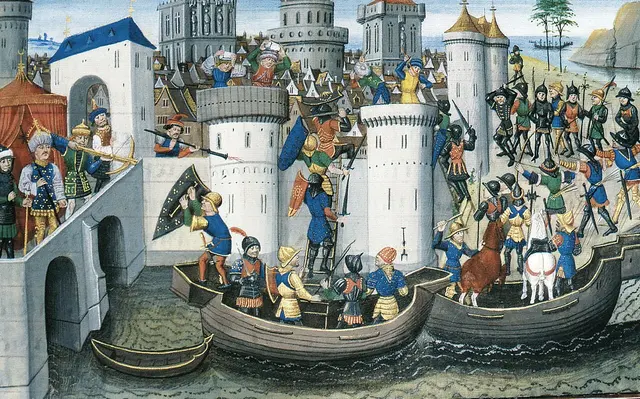
After the capture of Constantinople, an electoral college chose Count Baldwin of Flanders as Latin emperor; Baldwin was crowned in Hagia Sophia on 16 May 1204. By the Partitio Romaniae, Byzantine territory was divided among the emperor, Venice and the crusade leaders.
RESEARCH DOSSIER
Historical analysis of the event
Background
Under the agreement of March 1204, if the city were taken a college of six Venetian and six Frankish electors would choose the emperor. The side that did not win the empire would receive control of Hagia Sophia and the patriarchate. The candidates were the crusade's leaders, Boniface of Montferrat and Count Baldwin of Flanders.
The founding
On 9 May 1204 the electoral college chose Baldwin as emperor; Venice preferred Baldwin to Boniface, a stronger candidate with family ties to Byzantium. Baldwin was crowned in Hagia Sophia on 16 May. The Venetian Tommaso Morosini became Latin patriarch of Constantinople.
Under the partition document known as the Partitio Romaniae, the emperor received part of the city and a quarter of the imperial territory. The rest was divided equally between Venice and the Frankish leaders; Venice chose harbours and islands important for its trade routes. Boniface founded the Kingdom of Thessalonica.
Outcome and significance
The Latin Empire was weak from its founding: much of its territory existed only on paper, and the Byzantine successor states at Nicaea, Epirus and Trebizond did not recognise the new order. The Bulgarian tsar Kaloyan also fought the Latins; in 1205 Baldwin was captured at Adrianople.
The empire survived until 1261 but was gradually confined to Constantinople and its surroundings. Venice, for its part, gained from the partition territories such as Crete that formed the basis of its commercial empire in the eastern Mediterranean.
Sources and debates
Villehardouin describes the election and coronation as a participant. The text of the Partitio Romaniae is preserved in the Venetian archives. Niketas Choniates reports the first period of Latin rule critically from the Byzantine side. Venice's calculations behind the election are interpreted differently by historians.
Dates, places and figures in this record compare the principal narrative sources with modern scholarship. Where the sources disagree this is stated in the text; for a thesis or publication, consult the relevant edition and page reference.