7 June – 15 July 1099 · Jerusalem
Capture of Jerusalem
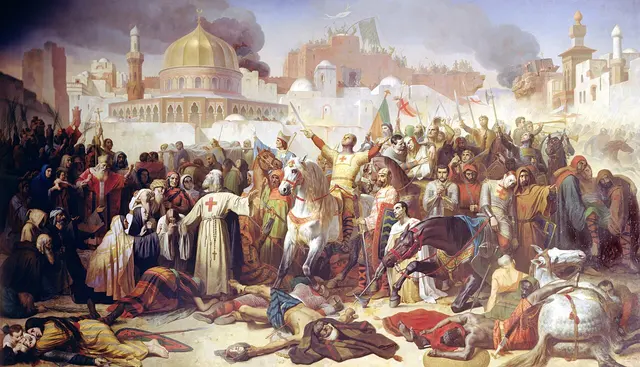
The crusader army arrived before Jerusalem on 7 June 1099. After a month-long siege it broke in through the northern walls on 15 July; the Fatimid governor Iftikhar al-Dawla surrendered the Tower of David and withdrew, while most of the city's inhabitants were killed.
RESEARCH DOSSIER
Historical analysis of the event
Background
The Fatimids had taken Jerusalem from the Artuqid emirs in 1098 while the crusaders besieged Antioch, and had even sent envoys proposing to share Syria with them. In spring 1099 the crusader army advanced south along the coast; Tripoli and other coastal emirates paid tribute to keep the road open. Jerusalem was defended by the Fatimid governor Iftikhar al-Dawla, who had poisoned wells, brought the surrounding flocks into the city and expelled part of the Christian population.
Course of events
The army arrived before the city on 7 June; a first assault on 13 June, made without enough ladders, failed. While thirst and heat strained the army, siege towers and catapults were built with materials from Genoese ships that reached Jaffa and timber brought from Samaria. A barefoot procession of the army around the Mount of Olives is described as an important boost to morale.
The general assault began on the night of 13–14 July. On the morning of 15 July Godfrey of Bouillon's tower reached the northern walls and the crusaders entered the city; in the south Raymond of Saint-Gilles's troops also crossed the walls. Iftikhar al-Dawla surrendered the Tower of David to Raymond and was allowed to leave for Ascalon with his men.
Outcome and significance
The entry into the city was followed by widespread killing and plunder. Latin sources describe wading in blood on the Temple Mount (al-Haram al-Sharif) in the language of religious triumph; Ibn al-Qalanisi reports that Jews were burned in their synagogue. Cairo Geniza documents show that some surviving Jews were ransomed.
The capture of Jerusalem resonated across the Latin world as the moment the First Crusade achieved its goal. In the Muslim world the event was long remembered as the result of political division and became one of the key memories behind later calls to jihad.
Sources and debates
The Gesta Francorum, Raymond of Aguilers and Fulcher present the events as a narrative of victory; Albert of Aachen writes that the killing continued in the following days. Ibn al-Athir's figure of 70,000 dead, written more than a century later, is considered greatly exaggerated. Historians such as Benjamin Kedar, comparing Latin and Arabic sources with the Geniza letters, have shown that the dead numbered in the thousands but that no exact figure can be given.
Dates, places and figures in this record compare the principal narrative sources with modern scholarship. Where the sources disagree this is stated in the text; for a thesis or publication, consult the relevant edition and page reference.