12 July 1109 · Tripoli
Capture of Tripoli and foundation of the county
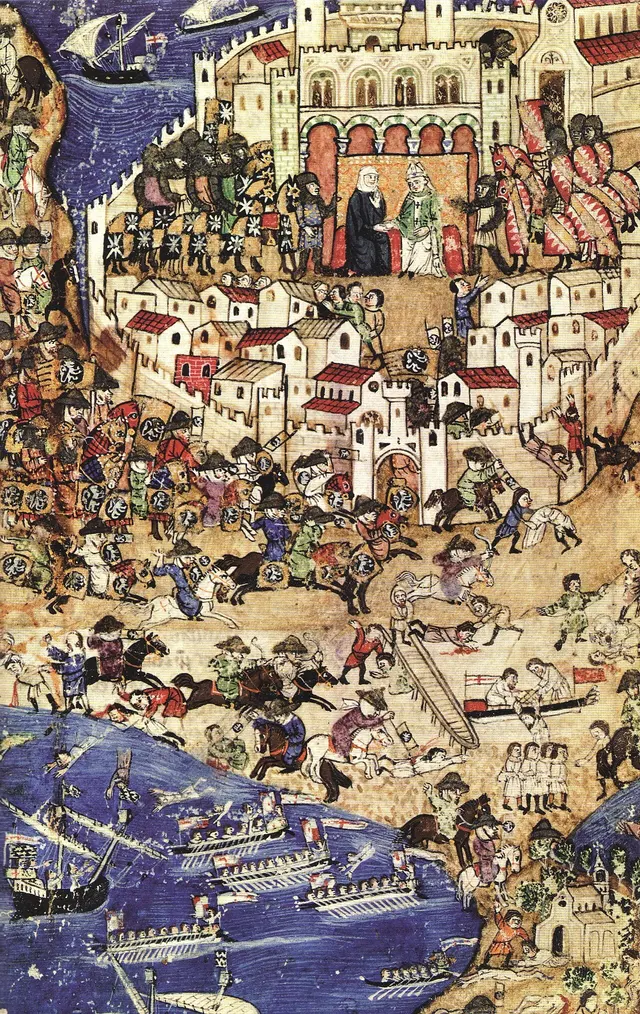
The siege of Tripoli begun by Raymond of Saint-Gilles in 1102 ended with the city's surrender on 12 July 1109, after his son Bertrand arrived with a Genoese fleet. The County of Tripoli was founded as the fourth and last major Latin state in the East.
RESEARCH DOSSIER
Historical analysis of the event
Background
Tripoli (in Lebanon) was a rich harbour city ruled by the Banu Ammar family. Having failed to obtain rule in Jerusalem, Raymond of Saint-Gilles set out to build a lordship on the Lebanese coast and took Tortosa in 1102. In 1103 he began the siege by building a castle on the hill opposite the city, later called the “Pilgrims' Castle” (Mons Peregrinus).
Course of events
Raymond died in 1105 with the siege still under way; his cousin William-Jordan continued it. In spring 1109 Raymond's son Bertrand arrived from Provence with a large Genoese fleet and claimed the inheritance. The dispute between the two claimants was settled by King Baldwin I's arbitration: Bertrand received Tripoli and William-Jordan the lands to the north; William-Jordan was killed shortly afterwards.
Fully blockaded by land and sea, the city surrendered on 12 July 1109 when the expected help from Egypt did not come. Despite the terms, those who entered the city plundered some quarters.
Outcome and significance
Bertrand became count of Tripoli as a vassal of the king of Jerusalem. The county joined the coastal strip between Antioch and Jerusalem, completing the map of the Latin East. The Genoese received extensive privileges in the city and at Jubayl; the Genoese Embriaco family ruled Jubayl for centuries. Tripoli remained in Latin hands until it was taken by the Mamluks in 1289.
Sources and debates
Albert of Aachen, Fulcher of Chartres and the Genoese Caffaro report the last phase of the siege; Ibn al-Qalanisi and Ibn al-Athir describe the city's surrender and the fate of its people. The story that the crusaders burned the famous library of the Banu Ammar, the Dar al-Ilm, rests on later sources and is disputed among historians.
Dates, places and figures in this record compare the principal narrative sources with modern scholarship. Where the sources disagree this is stated in the text; for a thesis or publication, consult the relevant edition and page reference.