May 1271 – September 1272 · Acre – Caesarea
Lord Edward's Crusade
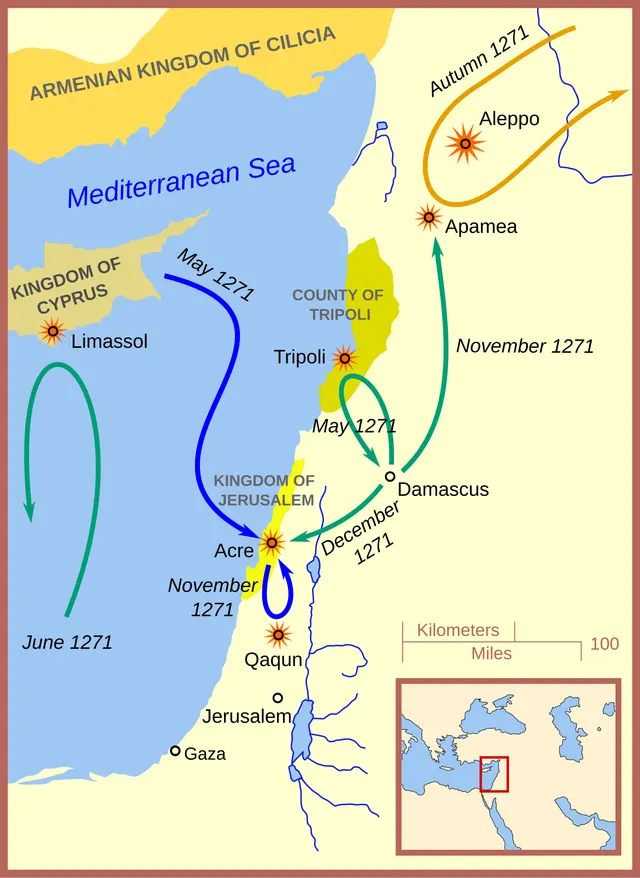
Prince Edward of England (later Edward I) reached Acre in May 1271 with a small army. Seeking coordination with the Mongol Ilkhanids, he made limited raids into Mamluk territory but achieved no lasting gain, and after the 1272 truce returned to Europe having survived an assassination attempt with wounds.
RESEARCH DOSSIER
Historical analysis of the event
Background
Edward had set out to join Louis IX's Tunis crusade but reached Carthage after the king had died. After the Tunis treaty he decided to continue his crusade and, having wintered in Sicily, headed for the Holy Land. He had only a few hundred knights and soldiers with him.
Course of events
Edward reached Acre on 9 May 1271. The state of the Latin East, and the Venetians and Genoese continuing to trade with the Mamluks, disappointed him. He sent envoys to the Mongol Ilkhan Abaqa proposing a joint operation; in October 1271 a Mongol force raided around Aleppo but soon withdrew.
In November 1271 Edward raided around Qaqun and attacked some Turkmen groups, but did not take the castle. Expected support from Cyprus remained limited because the Cypriot barons would not accept an obligation to serve outside the island.
Outcome and significance
In May 1272 King Hugh I of Jerusalem and Cyprus made a ten-year truce with Baybars. In June 1272 Edward was wounded with a poisoned dagger by an assassin who approached him as an envoy; after recovering he left Acre in September 1272. When he reached England his father Henry III had died and Edward became king.
As one of the last significant crusades from the West, Edward's expedition showed the limits of the search for Latin–Mongol cooperation.
Sources and debates
English chronicles and the Gestes des Chiprois report the crusade. The assassination attempt, and stories such as his wound being sucked clean by his wife Eleanor, contain later legendary elements. Whether the assassin was sent by Baybars or by some other circle is debated.
Dates, places and figures in this record compare the principal narrative sources with modern scholarship. Where the sources disagree this is stated in the text; for a thesis or publication, consult the relevant edition and page reference.