22 May 1272 · Caesarea
Baybars–Edward truce
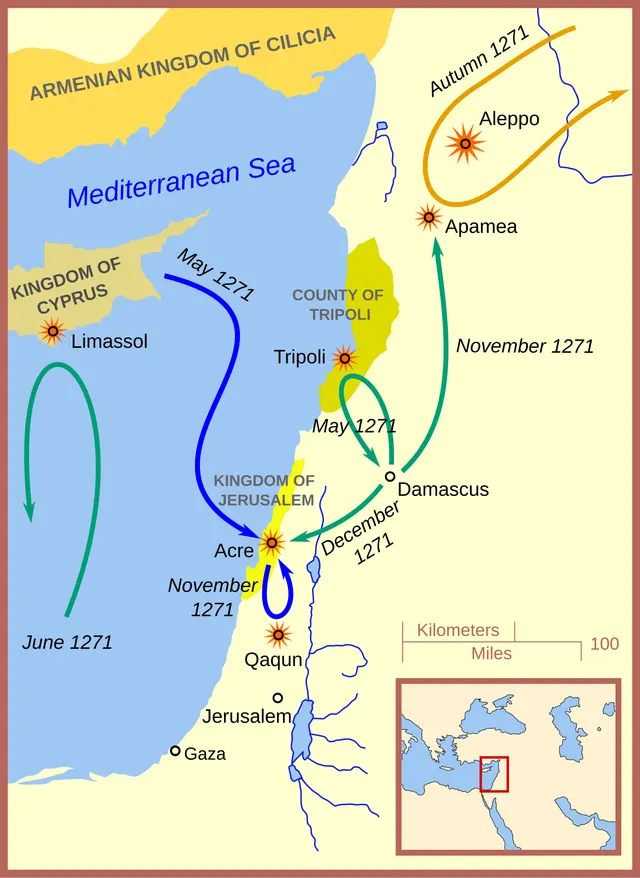
On 22 May 1272 at Caesarea, a truce of ten years, ten months and ten days was signed between Baybars and King Hugh I of Jerusalem and Cyprus. By securing Acre and the pilgrim road to Nazareth, the truce effectively ended Lord Edward's crusade.
RESEARCH DOSSIER
Historical analysis of the event
Background
As Lord Edward's small army and his attempt at coordination with the Mongols produced limited results, the barons of Acre and King Hugh I of Cyprus chose to come to terms with Baybars. Baybars, for his part, did not want a long war with Acre because of the Mongol threat and his northern campaigns.
The agreement
The truce was signed at Caesarea on 22 May 1272. It secured the safety of Acre and the surrounding Latin lands and of the pilgrim road from Acre to Nazareth. The parties set the borders and the sharing of village revenues.
The truce's length was set at ten years, ten months and ten days, a term common in Mamluk–Latin treaties. Edward was not a party to the treaty, but after it his crusade had no purpose left.
Outcome and significance
The truce gave Acre more than a decade of relative stability, and no major attacks were made on the kingdom until Baybars's death in 1277. Qalawun too signed a new truce in 1283.
The treaty shows that in the second half of the thirteenth century the Latin states owed their existence more to treaties with the Mamluks than to military strength.
Sources and debates
The text of the treaty does not survive; its terms are inferred from Mamluk sources, especially Ibn Abd al-Zahir, and Latin chronicles. Peter Holt's study of Mamluk–Frankish treaties has examined the diplomatic documents of this period comparatively.
Dates, places and figures in this record compare the principal narrative sources with modern scholarship. Where the sources disagree this is stated in the text; for a thesis or publication, consult the relevant edition and page reference.