September 1101 · Iconium–Heraclea
Armies of 1101 dispersed at Konya and Heraclea
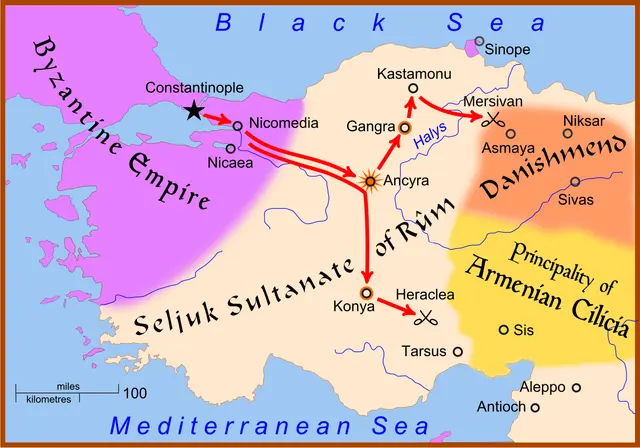
The army of Count William of Nevers, and that of Duke William IX of Aquitaine and Duke Welf of Bavaria, entered Anatolia by routes separate from Merzifon. Both were destroyed on the Konya–Ereğli line in late August and September 1101 by thirst and Seljuk attacks.
RESEARCH DOSSIER
Historical analysis of the event
Background
The 1101 crusade was not a single army but separate columns moving a few weeks apart. While the Lombard army headed for Merzifon, the French army of Count William of Nevers, followed by the Aquitaine–Bavaria army led by William IX and Welf IV, advanced toward Konya along the First Crusade's southern route. After their victory at Merzifon, the Seljuk and Danishmendid forces had time to turn south.
Course of events
The count of Nevers's army came south through Ankara, failed to take Konya and advanced toward Ereğli. In late August near Ereğli the army, out of water, was scattered by Turkish archers; William reached Antioch with a small group.
The Aquitaine and Bavarian army following behind met scorched earth and dried-up wells on the same road. In early September, trying to reach water at a river near Ereğli, it was ambushed. Welf and William IX escaped and reached Antioch; the fate of important figures such as Countess Ida of Austria is unknown.
Outcome and significance
Together with Merzifon, the defeats at Konya and Ereğli turned the 1101 crusade into a disaster. Small surviving groups made the pilgrimage to Jerusalem and fought beside Baldwin at the Second Battle of Ramla in 1102. These defeats showed that Anatolia was no safe supply corridor for Latin armies, and the next great Western army would not try the route until 1147.
Sources and debates
Albert of Aachen, Ekkehard of Aura and Orderic Vitalis report the events, with differences of date and place among them. Exactly where around Ereğli the battles were fought is unclear. The sources' accusation that Byzantium deliberately misled the armies reflects later Latin–Byzantine mistrust and is unproven.
Dates, places and figures in this record compare the principal narrative sources with modern scholarship. Where the sources disagree this is stated in the text; for a thesis or publication, consult the relevant edition and page reference.