7 September 1101 · Ramla
First Battle of Ramla
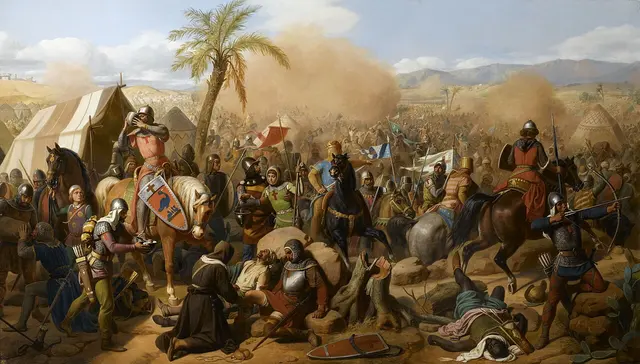
On 7 September 1101 an army sent by the Fatimid vizier al-Afdal met the much smaller force of Baldwin I near Ramla. Despite heavy losses, Baldwin's cavalry charge scattered the Fatimid army and the southern approach to the Kingdom of Jerusalem was held.
RESEARCH DOSSIER
Historical analysis of the event
Background
After the defeat at Ascalon the Fatimids did not give up on recovering Palestine. The army gathered at Ascalon threatened Ramla, on the Jaffa–Jerusalem road, and the kingdom's presence on the coast. Even after the coastal conquests of spring 1101, Baldwin had only a few hundred knights and limited infantry.
Course of events
On learning that the Fatimid army was advancing, Baldwin marched south from Caesarea and divided his force of about 260 knights and 900 infantry into several divisions. In the battle on 7 September on the plain between Ramla and Ibelin, the first Frankish divisions suffered heavy losses.
The charge of the reserve cavalry division under Baldwin's own command broke the Fatimid centre and the army dispersed. The Fatimid commander Sa'd al-Dawla was killed in the battle; the fleeing units withdrew to Ascalon.
Outcome and significance
The victory temporarily secured the southern approach to Jerusalem and strengthened Baldwin's military reputation. But the Fatimid threat did not end; in the same Ramla–Jaffa corridor there was a heavy Frankish defeat in 1102 and another Frankish victory in 1105. These three battles show the role of disciplined use of a small heavy cavalry force in preserving the kingdom.
Sources and debates
Fulcher of Chartres, who describes the battle in most detail, was with Baldwin and gives the figures for the Frankish forces. Figures for the size of the Fatimid army are exaggerated. Arabic sources mention the battle only briefly.
Dates, places and figures in this record compare the principal narrative sources with modern scholarship. Where the sources disagree this is stated in the text; for a thesis or publication, consult the relevant edition and page reference.