20 October 1097 – 28 June 1098 · Antioch
Siege of Antioch
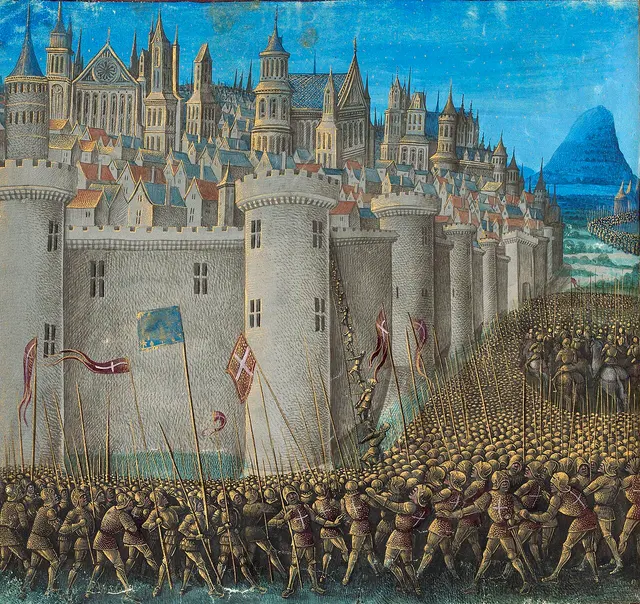
The crusader army besieged Antioch from October 1097. After a winter of severe famine, the city was taken on 3 June 1098 through a tower opened from within; the crusaders were then besieged by Kerbogha's relief army, which they defeated in battle on 28 June.
RESEARCH DOSSIER
Historical analysis of the event
Background
With its strong walls and a citadel set against the mountains, Antioch was one of the most important cities of northern Syria. It was governed by Yaghi-Siyan, appointed by the Seljuk sultan Malikshah; neighbouring Seljuk rulers such as Ridwan in Aleppo, Duqaq in Damascus and Kerbogha in Mosul were rivals. This fragmentation allowed the crusaders to sustain a long siege.
Course of events
The siege began on 20–21 October 1097, but the length of the walls made a complete blockade impossible. Through the winter famine and disease spread in the crusader army; relief forces sent by Duqaq at the end of December and by Ridwan on 9 February 1098 were repulsed during foraging raids. With materials brought by English and Genoese ships that reached the port of Saint-Simeon in March, towers were built before the bridge gate.
Bohemond came to an agreement with Firuz, an Armenian convert defending one of the city's towers. On the night of 2–3 June the crusaders climbed the walls from this tower and entered the city; most of the population was killed or fled. Yaghi-Siyan was killed while fleeing, but the citadel remained in the hands of his son Shams al-Dawla.
A few days later Kerbogha's great coalition army arrived and the crusaders found themselves besieged inside the city. As hunger and desertion grew, Peter Bartholomew's announcement that he had found the Holy Lance lifted the army's morale. On 28 June the crusaders sallied out and attacked; when some of the coalition's emirs left the field, Kerbogha's army dissolved and the citadel surrendered.
Outcome and significance
The capture of Antioch was the turning point that decided the expedition's fate. Alexios abandoned his march to help after hearing the gloomy reports of Count Stephen of Blois, who had fled during the siege; this became the crusaders' justification for not handing the city to Byzantium. Under Bohemond, the city became the centre of the Principality of Antioch.
Sources and debates
The Gesta Francorum, Raymond of Aguilers and Fulcher describe the siege as crusader witnesses; Raymond is the most fervent defender of the Holy Lance episode. Ibn al-Athir and Ibn al-Qalanisi blame the defeat on internal disputes within the Muslim coalition and Kerbogha's arrogance. The authenticity of the Holy Lance was disputed even within the crusader army, and Peter Bartholomew died after an ordeal by fire in 1099.
Dates, places and figures in this record compare the principal narrative sources with modern scholarship. Where the sources disagree this is stated in the text; for a thesis or publication, consult the relevant edition and page reference.