October – November 1146 · Edessa
Second capture of Edessa
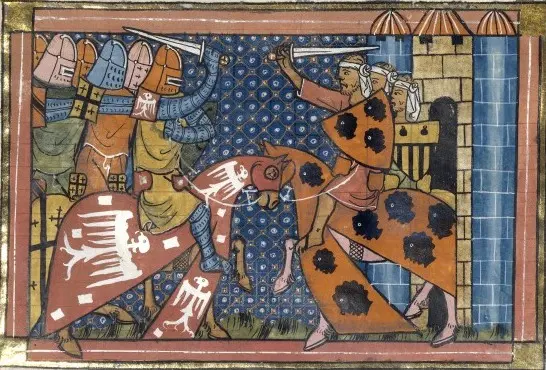
After Zengi's death in September 1146, Joscelin II entered Edessa in October 1146 with the support of its Armenian population but could not take the citadel. Nur al-Din Zengi soon arrived and routed the Franks and the inhabitants trying to flee with them; the city's Christian population suffered heavy losses.
RESEARCH DOSSIER
Historical analysis of the event
Background
Imad al-Din Zengi was killed by a servant in September 1146 during the siege of the castle of Ja'bar. His lands were divided among his sons: Mosul went to Sayf al-Din Ghazi and Aleppo to Nur al-Din Mahmud. Some of Edessa's Armenian population used this period of transition to call back their former count.
Course of events
Joscelin II and Baldwin, lord of Marash, entered the city by night with a small force in October 1146. But they could not take the citadel held by the Turkish garrison, and they had no siege equipment.
Nur al-Din arrived within days with a large army. Caught between the citadel and the army outside, the Franks decided to leave the city and withdraw toward the Euphrates. Most of the population left through the gates with them. Nur al-Din's forces attacked the fleeing crowd; Baldwin of Marash was killed and Joscelin barely escaped to Samosata. Most of those left behind were killed or carried off as slaves.
Outcome and significance
After these events Edessa's Christian population was largely dispersed and the city lost its former importance. The county was confined to the area around Turbessel west of the Euphrates; Joscelin II was captured in 1150, and the remaining castles were sold to Byzantium or fell to the Muslims in 1150–1151.
The episode occurred while the Second Crusade was being organised in the West, making its aim of recovering Edessa even less realistic. Nur al-Din, for his part, gained prestige as Zengi's successor through this victory.
Sources and debates
The chronicle of Michael the Syrian and the Anonymous Syriac Chronicle describe the sufferings of the city's Christian population in detail and with bitterness. Ibn al-Qalanisi and Ibn al-Athir present the episode as the suppression of a revolt. The scale of the losses and the dating of events differ between sources.
Dates, places and figures in this record compare the principal narrative sources with modern scholarship. Where the sources disagree this is stated in the text; for a thesis or publication, consult the relevant edition and page reference.