1198–1199 · Acre
Teutonic Knights become a military order
The hospital brotherhood founded for German pilgrims at the siege of Acre in 1190 was turned into a military order in a ceremony at Acre in March 1198. With Pope Innocent III's approval in 1199, the Teutonic Knights became a permanent military-religious organisation like the Templars and Hospitallers.
RESEARCH DOSSIER
Historical analysis of the event
Background
During the siege of Acre in 1190, pilgrims from Lübeck and Bremen founded a hospital for sick and wounded German soldiers. The hospital came under the patronage of Duke Frederick of Swabia and was approved by Pope Clement III in 1191. After Acre was taken, the hospital moved to a building in the city.
The transformation
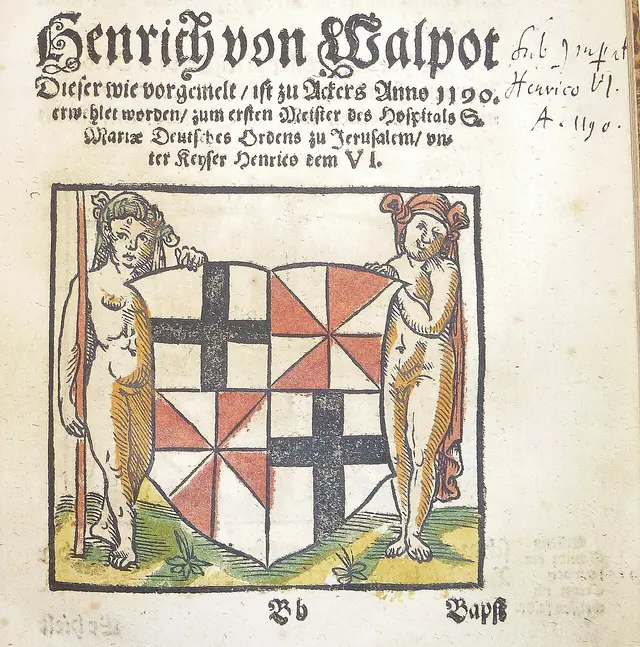
In March 1198, at a meeting in the Templar house at Acre attended by the leaders of the German Crusade, the king of Jerusalem and the masters of the Templars and Hospitallers, the brotherhood was turned into a military order. Heinrich Walpot was elected its first master.
In February 1199 Pope Innocent III approved that the order's knights follow the Templar rule and its care of the sick the Hospitaller rule. The order's formal name was “the Hospital of St Mary of the Germans in Jerusalem”.
Outcome and significance
In the thirteenth century the Teutonic Knights grew rapidly under the mastership of Hermann von Salza with the support of Frederick II. In the Levant they built the castle of Montfort (Starkenberg) and took part in the defence of Acre. But from the 1220s the order's real centre of gravity shifted to the campaigns in Prussia and the Baltic.
The order's founding shows that the crusading movement had entered a phase in which different national communities created their own institutions.
Sources and debates
The most important source for the order's founding is the De primordiis ordinis Theutonici narratio, written in the thirteenth century; it also contains later founding traditions. Papal documents and imperial charters show the legal stages of the founding. Some details about the hospital's founders and its role in the early years are disputed.
Dates, places and figures in this record compare the principal narrative sources with modern scholarship. Where the sources disagree this is stated in the text; for a thesis or publication, consult the relevant edition and page reference.