26 March 1169 · Cairo
Saladin becomes Fatimid vizier
After Shirkuh died in March 1169, his nephew Saladin (Salah al-Din Yusuf) was appointed vizier by the Fatimid caliph al-Adid on 26 March 1169. Appearing at first loyal both to the Fatimid caliph and to Nur al-Din, Saladin soon established his own power in Egypt.
RESEARCH DOSSIER
Historical analysis of the event
Background
Shirkuh, who became Fatimid vizier in January 1169, died only two months later, on 23 March. There was rivalry among the commanders of the Syrian army in Egypt over who would succeed him. The Fatimid palace, for its part, wanted to limit the power of this army from Syria.
The appointment
Caliph al-Adid appointed Shirkuh's nephew Saladin, then about thirty, as vizier. According to the sources, the palace thought a young and relatively inexperienced commander would be easier to control. Saladin's selection was made acceptable to the other emirs with the support of the Kurdish circle, including the jurist Isa al-Hakkari.
Like the Fatimid viziers, Saladin took the title “al-Malik al-Nasir”, but he remained loyal to Nur al-Din and appeared to follow his instructions.
Outcome and significance
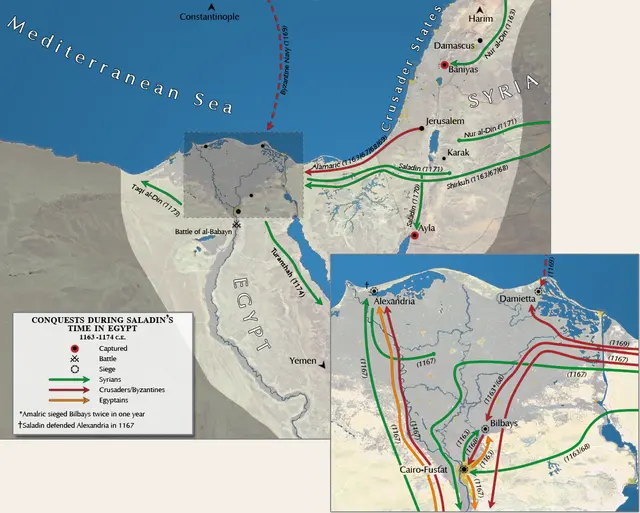
Saladin soon crushed a revolt of the Sudanese and Armenian units of the Fatimid army and replaced them with his own Kurdish and Turkish troops. His father Najm al-Din Ayyub and his family came to Egypt. In autumn 1169 he successfully defended Damietta against the joint Jerusalem–Byzantine fleet.
The vizierate was the step that let Saladin take control of Egypt's resources and end the Fatimid caliphate in 1171. His relations with Nur al-Din, meanwhile, grew increasingly tense.
Sources and debates
Baha al-Din ibn Shaddad and Imad al-Din al-Isfahani, writing from Saladin's close circle, describe his rise favourably. Ibn al-Athir, close to the Zengid family, reports Saladin's attitude toward Nur al-Din more critically. The court calculations behind the appointment are interpreted differently in the sources.
Dates, places and figures in this record compare the principal narrative sources with modern scholarship. Where the sources disagree this is stated in the text; for a thesis or publication, consult the relevant edition and page reference.