20 September – 2 October 1187 · Jerusalem
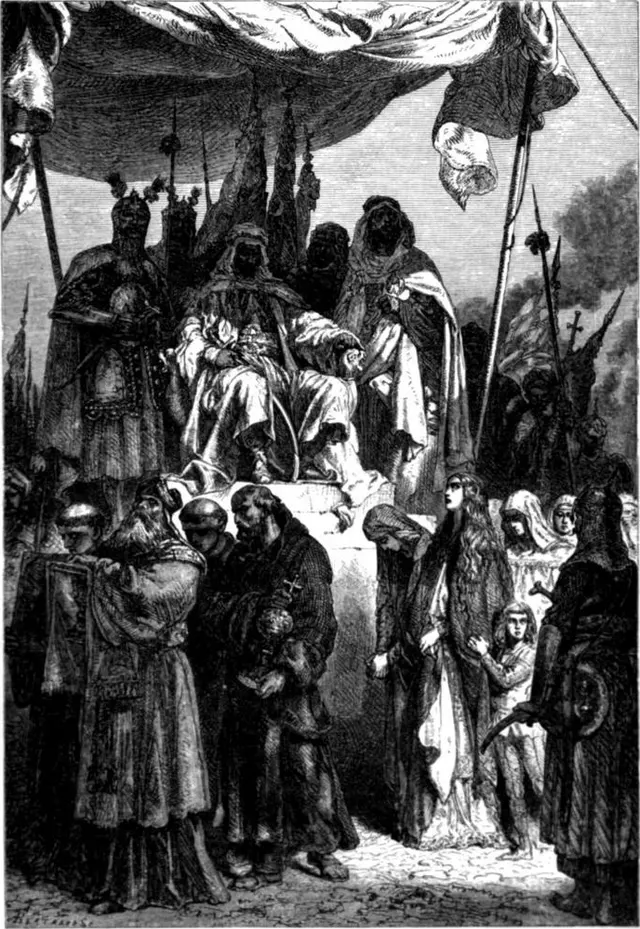
Surrender of Jerusalem to Saladin
Saladin besieged Jerusalem on 20 September 1187. After a breach was opened in the walls, negotiations led by Balian of Ibelin ended with the city's surrender by agreement on 2 October. The departure of the Latin population was tied to a ransom per person; some who could not pay were released, others enslaved.
RESEARCH DOSSIER
Historical analysis of the event
Background
After Hattin most coastal cities had surrendered to Saladin. Jerusalem had very few knights; the city was crowded with refugees from the surrounding area. Balian of Ibelin, who had come with Saladin's permission to fetch his wife to Tyre, took over the city's defence at the people's request and knighted the men who could fight.
Course of events
Saladin arrived west of the city on 20 September, but finding the walls there strong, he shifted his army north, toward the Damascus Gate and the Mount of Olives. From 26 September sappers and catapults pounded the walls, and on 29 September a section of wall collapsed.
Balian went out to negotiate with Saladin. Saladin said at first that he wanted to take the city by force in revenge for the massacre of 1099. Balian bargained by saying that if terms were refused, the defenders would kill the Muslim prisoners in the city and destroy the Dome of the Rock and the al-Aqsa Mosque. In the end it was agreed that the city would be surrendered for a ransom of 10 dinars for men, 5 for women and 2 for children. The city was handed over on 2 October 1187, a day coinciding with the anniversary of the Prophet's Night Journey and Ascension.
Outcome and significance
For the poor who could not pay, Balian used the donation of King Henry II of England held by the Hospitallers to secure the release of some 7,000 people for 30,000 dinars. Saladin and his brother al-Adil also released thousands of poor people without ransom. Even so, thousands who could not pay were carried off as captives.
Orthodox, Syriac and Armenian Christians were allowed to remain in the city. The cross on top of the Dome of the Rock was taken down, and the al-Aqsa Mosque was cleansed and restored as a mosque. The loss of Jerusalem caused great shock in Europe and launched the Third Crusade.
Sources and debates
Imad al-Din al-Isfahani reports the details of the surrender and ransom as a witness; the account attributed to Ernoul emphasises Balian's role. The number of those unable to pay and of those enslaved varies widely between sources. Saladin's restraint at the surrender of the city also contributed to his idealisation in later European literature.
Dates, places and figures in this record compare the principal narrative sources with modern scholarship. Where the sources disagree this is stated in the text; for a thesis or publication, consult the relevant edition and page reference.