1182 – 1183 · Aqaba – Yanbu
Raynald's Red Sea expedition
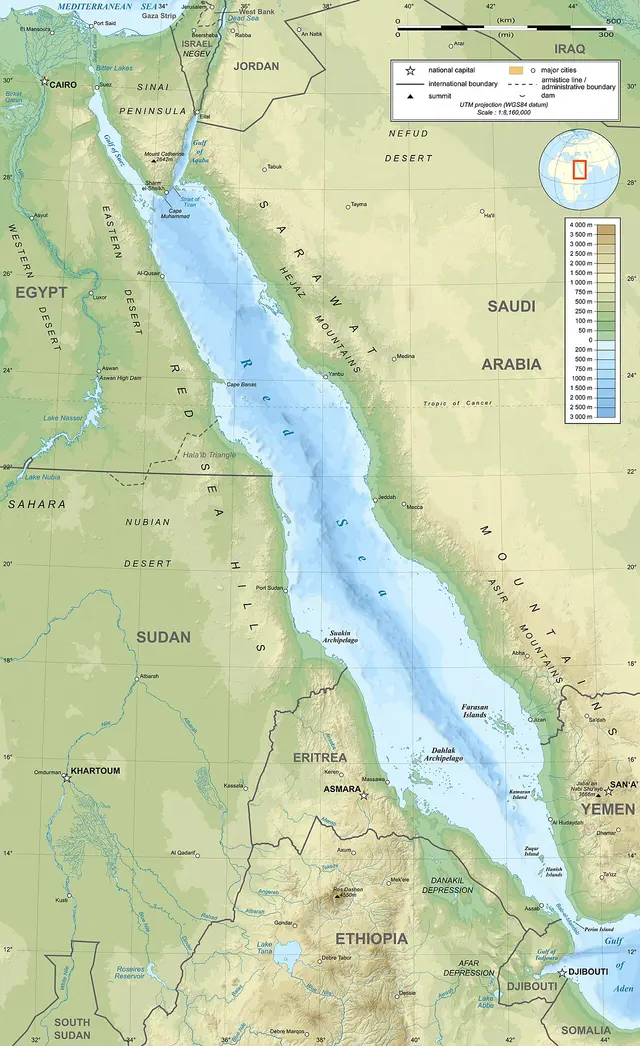
In the winter of 1182–1183 Reynald of Châtillon launched ships, carried overland in pieces, into the Gulf of Aqaba. The raiders attacked ports on the Red Sea coast and merchant and pilgrim ships; an Ayyubid fleet under Admiral Husam al-Din Lu'lu' stopped the expedition.
RESEARCH DOSSIER
Historical analysis of the event
Background
Reynald, lord of Kerak and Shawbak, used his position astride the caravan routes between Egypt and Syria to raid the region. In 1181 he had led a raid as far as Tayma. The Red Sea was the heart of Egypt's Indian trade and of the pilgrim route to Mecca and Medina; the crusaders had never before reached it.
Course of events
Reynald had ships built at Kerak carried in pieces by camel to the Gulf of Aqaba. At the end of 1182 they were launched. One group besieged the Ayyubid fort on the island off Ayla (Aqaba); others went south and attacked Aydhab on the Egyptian coast and ports on the Hijaz coast, plundering merchant ships and ships carrying pilgrims.
Al-Adil, who governed Egypt, sent a fleet under Admiral Husam al-Din Lu'lu'. In February 1183 Lu'lu' lifted the siege at Ayla, then caught the raiders who had landed on the Hijaz coast near al-Hawra. Some of the captives were executed at Mina near Mecca, others in Cairo and Alexandria.
Outcome and significance
The expedition's military impact was limited, but it caused great anger in the Muslim world. Seen as a threat to the holy cities, it led Saladin to vow to punish Reynald personally, a vow fulfilled by Reynald's execution after Hattin in 1187.
The expedition stands out as the only major Latin naval operation in the Red Sea during the crusading period.
Sources and debates
The fullest witness is the traveller Ibn Jubayr, who passed through the region at the time and also reports the execution of the captives. Imad al-Din al-Isfahani and Abu Shama, and the Latin account attributed to Ernoul, also provide information. Whether Reynald directly targeted Mecca or Medina is debated; Muslim sources stress this threat.
Dates, places and figures in this record compare the principal narrative sources with modern scholarship. Where the sources disagree this is stated in the text; for a thesis or publication, consult the relevant edition and page reference.