August 1096 · Constantinople
People's Crusade reaches Constantinople
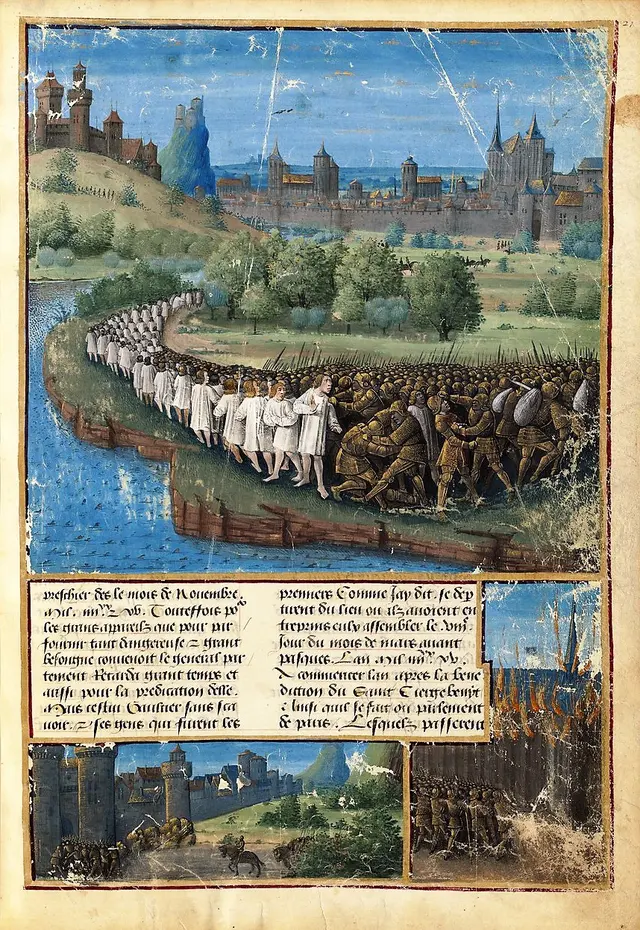
The disorderly bands around Peter the Hermit and Walter Sans-Avoir reached Constantinople in August 1096. Because of their excesses in the Balkans, Alexios I soon ferried them across the Bosporus to the camp at Kibotos (Civetot).
RESEARCH DOSSIER
Historical analysis of the event
Background
Preaching in northern France and the Rhineland after Clermont, Peter the Hermit mobilised large numbers of peasants, townspeople and clergy alongside knights. These bands set out in spring 1096 without waiting for the aristocratic armies' departure date of 15 August 1096. Walter Sans-Avoir's group, travelling ahead, arrived at Constantinople in July.
Course of events
As Peter's column crossed Hungary, a dispute over supplies at Zemun (Semlin) turned violent and the town was plundered. At Niš a clash with the Byzantine governor cost the column heavy losses. From then on the Byzantine authorities supplied the crowd and escorted it under supervision to the capital; Peter reached Constantinople on 1 August 1096.
According to Anna Komnene, the emperor received Peter and advised him to wait for the princes' armies. But as plunder and theft increased around the city, Alexios within days ferried the bands across the Bosporus and settled them at the camp of Kibotos (Civetot) on the Gulf of Nicomedia.
Outcome and significance
In the camp a split opened between the French and the German-Italian groups, and each began separate raids around Nicaea. This division and indiscipline prepared the ground for the defeats at Xerigordos and Civetot a few weeks later. For Byzantium this first experience also marked the start of a cautious, supervisory attitude toward the Western armies that followed.
Sources and debates
The fullest sources are Albert of Aachen and Anna Komnene's Alexiad; the Gesta Francorum also contains a short account. The numbers of the bands are given in the tens of thousands and are uncertain. Since Anna wrote decades after the events and was distant toward the Latins, her account should be read against Albert's Western perspective.
Dates, places and figures in this record compare the principal narrative sources with modern scholarship. Where the sources disagree this is stated in the text; for a thesis or publication, consult the relevant edition and page reference.