July – 2 September 1192 · Jaffa
Battle of Jaffa and peace treaty
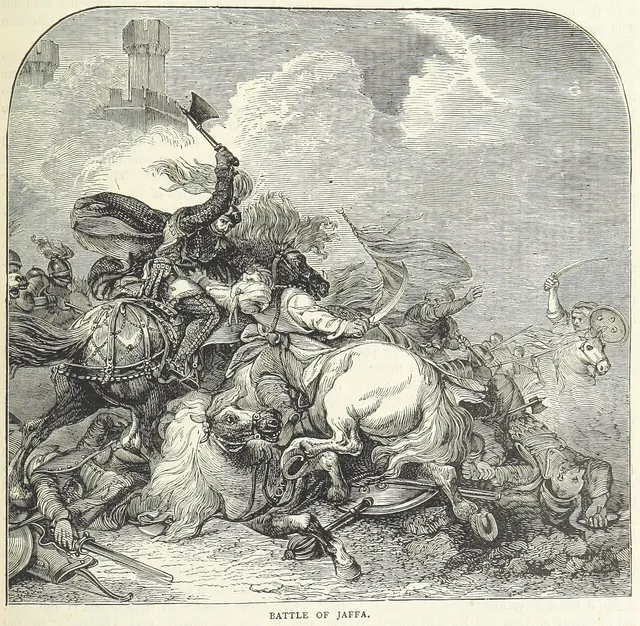
In July 1192 Saladin took Jaffa in a surprise attack; Richard arrived by sea, retook the city and on 5 August defended his camp with very few knights. On 2 September 1192 the two sides signed the Treaty of Jaffa: the coastal strip stayed with the Franks, Jerusalem stayed under Muslim rule, and pilgrims were granted free access.
RESEARCH DOSSIER
Historical analysis of the event
Background
In summer 1192, having approached Jerusalem a second time and withdrawn, Richard began preparing an operation against Beirut in the north. Learning that Richard was at Acre, Saladin besieged Jaffa on 27 July. The town fell within days; the defenders in the citadel kept resisting while negotiating terms of surrender.
Course of events
Richard sailed south from Acre and reached Jaffa on the night of 31 July–1 August. Jumping from his ship into the water, he landed with a few men and retook the town. On the morning of 5 August Saladin's army attacked the small crusader camp outside the town. Richard beat off the attacks with only a few dozen mounted knights and a tight defensive line of spearmen and crossbowmen.
After this clash both sides were exhausted and sick. Richard had to return because of troubles in England; Saladin's army was weary of the long war. Negotiations accelerated through al-Adil, and the treaty was signed on 2 September 1192.
Outcome and significance
The treaty provided for a truce of three years and eight months. The coastal strip from Tyre to Jaffa was left to the Franks; Ascalon's walls were to be demolished and the town left empty. Christian pilgrims were allowed to visit Jerusalem and the holy places, and Muslim and Christian merchants could pass freely through both territories.
Richard left Acre on 9 October 1192; on the way home he was captured by Duke Leopold of Austria. The treaty ended the Third Crusade and set the borders of the Acre-centred Kingdom of Jerusalem.
Sources and debates
The Itinerarium peregrinorum and Ambroise describe Richard's defence of Jaffa in legendary terms. Baha al-Din ibn Shaddad reports in detail the reluctance in Saladin's army and the treaty negotiations. The length of the truce and the details of the borders are given with small differences in the sources.
Dates, places and figures in this record compare the principal narrative sources with modern scholarship. Where the sources disagree this is stated in the text; for a thesis or publication, consult the relevant edition and page reference.