25 November 1177 · near Ramla
Battle of Montgisard
On 25 November 1177 the sixteen-year-old King Baldwin IV of Jerusalem routed Saladin's army from Egypt with a surprise attack at Montgisard near Ramla. Saladin barely escaped back to Egypt; the victory gave the kingdom a few years' respite.
RESEARCH DOSSIER
Historical analysis of the event
Background
In autumn 1177 Count Philip of Flanders had come to the Holy Land with a large force, but no agreement was reached on a joint expedition to Egypt. Philip went north with the forces of Antioch and Tripoli to besiege Harim. Taking advantage of the absence of much of the kingdom's army, Saladin entered Palestine from Egypt with a large army in November.
Course of events
Baldwin IV entered Ascalon to try to block Saladin, but the Egyptian army advanced into the kingdom's interior and burned Ramla. Treating his victory as certain, Saladin let his troops disperse over a wide area to plunder.
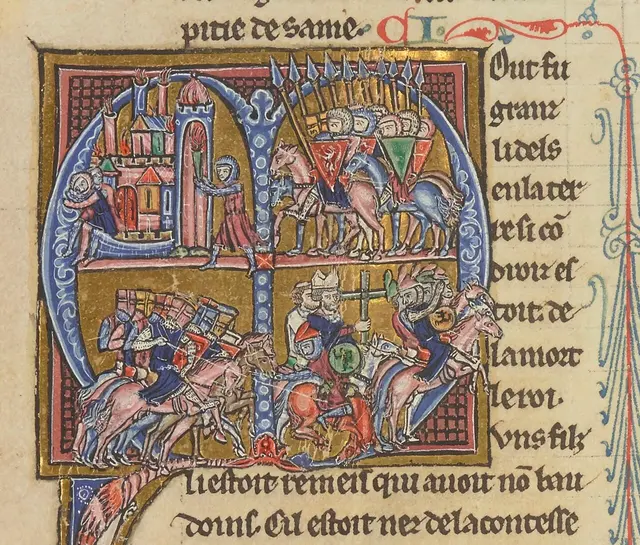
The king, with Reynald of Châtillon and a small number of knights, left Ascalon and followed the coast road; the Templars from Gaza joined them. On 25 November near Montgisard they attacked the Egyptian army, which had lost its formation and was not expecting the Frankish force bearing the True Cross. The army broke; Saladin's guard suffered heavy losses and the sultan barely escaped.
Outcome and significance
During the retreat across the Sinai desert the Egyptian army lost still more to Bedouin attacks and lack of supplies. Montgisard was one of the heaviest defeats of Saladin's career.
But the victory did not remedy the kingdom's shortage of manpower and resources. Saladin soon recovered and took his revenge on the Franks at Marj Uyun in 1179. The battle entered Latin memory as a story symbolising the courage of the sick young king.
Sources and debates
William of Tyre and the account attributed to Ernoul give the Latin view; Imad al-Din al-Isfahani, Abu Shama and Ibn al-Athir acknowledge the defeat and report Saladin's mistakes. The size of the Frankish army (a few hundred knights) and of the Egyptian army differ between sources. The exact site of the battle is disputed.
Dates, places and figures in this record compare the principal narrative sources with modern scholarship. Where the sources disagree this is stated in the text; for a thesis or publication, consult the relevant edition and page reference.